A Trek to Remember
A Trek To Remember
Gosaikunda Trek
People believe that a dip in the sacred Gosainkunda — a freshwater lake situated at an altitude of 4,380 meters — washes away all your sins. Gosainkunda is a holy destination for Hindu pilgrims from all over the world. Every year in August, during the Janai Purnima festival, many Hindu pilgrims are attracted to take a dip in the holy pond. The sacred pond and the vicinity, being part of Langtang National Park, attract Hindu pilgrims, trekkers, and adventure lovers worldwide. Gosaikunda Trek is the best trekking trail for adventure seekers and nature lovers.
There are altogether 17 ponds—Gosaikunda, Bhairavkunda, Sarswati Kunda, Kyamachho Kunda, Dudh Kunda, Rakta Kunda, Chandra Kunda, Surya Kunda, Ganesh Kunda, Batas Kunda, Lam Kunda, Ekle Kunda, Raj Kunda, Tinchuli Kunda, Nau Kunda, and Jhyakunchuli Kunda—in the Gosainkunda area. Gosainkunda and its associated lakes have been listed in the Ramsar list of wetlands.
Every adventure seeker dreams of visiting this sacred pond and the beautiful Langtang region. I was already offered a chance to cover a sporting event being organized in the Gosaikunda area. The event was the ‘1st TAAN Gosaikunda Half-Marathon 2016,’ organized by the Trekking Agencies Association of Nepal (TAAN).
My Experience
I was ready for the trip. We were invited for a briefing at the TAAN Secretariat. TAAN officials informed us that the event was being organized to spread the message that the Gosainkunda region, hit hard by the 2015 earthquakes, is now safe for trekking.
On the morning of May 26, a team of around 30 journalists left for Dhunche under the leadership of TAAN Media Coordinator Surya Bahadur Ghimire. The TAAN Operation Officer was to be our liaison officer.
After negotiating the valley traffic and the bends below Nagdhunga, we reached Naubise, where the road is a bit wider and more comfortable. Our first stop was Galchhi, where we had our breakfast. After resting there for a while, we continued our drive to Dhunche—the district headquarters of Rasuwa.
The trip was enjoyable. Talking with fellow journalists, it felt good to know that I was not the only one going to Gosainkunda for the first time. Our liaison officer, Mr. Dangol, was with me all the way, and he was putting in all his efforts to make the trip memorable. It was his seventh trip to Gosainkunda. He was informing us about the significant milestones along the road. When we reached Devighat, he reported that it was at this very place that the late King Prithvi Narayan Shah breathed his last. We could see the statue of Prithvi Narayan Shah standing tall there. It felt good to be at such a historically significant place.
We continued our trip, and on the way, we had to pass through the landslide-hit Ramche section of the Kathmandu–Syafrubesi Road. After negotiating the hazardous area of a few kilometers, we finally reached Dhunche at around 1 pm. Dhunche is the district headquarters of Rasuwa and the gateway to the Langtang and Gosainkunda region. After lunch and a brief rest at Dhunche, we started the trek to Gosaikunda at around 3 pm.
Lifetime Experience
We were on the trip of our lifetime. After some descent, we reached a place called Ghattekhola. As it started raining before we got to the site, most of us used raincoats or umbrellas. While climbing up, we could see people repairing the trail that suffered minor damages during last year's earthquakes.
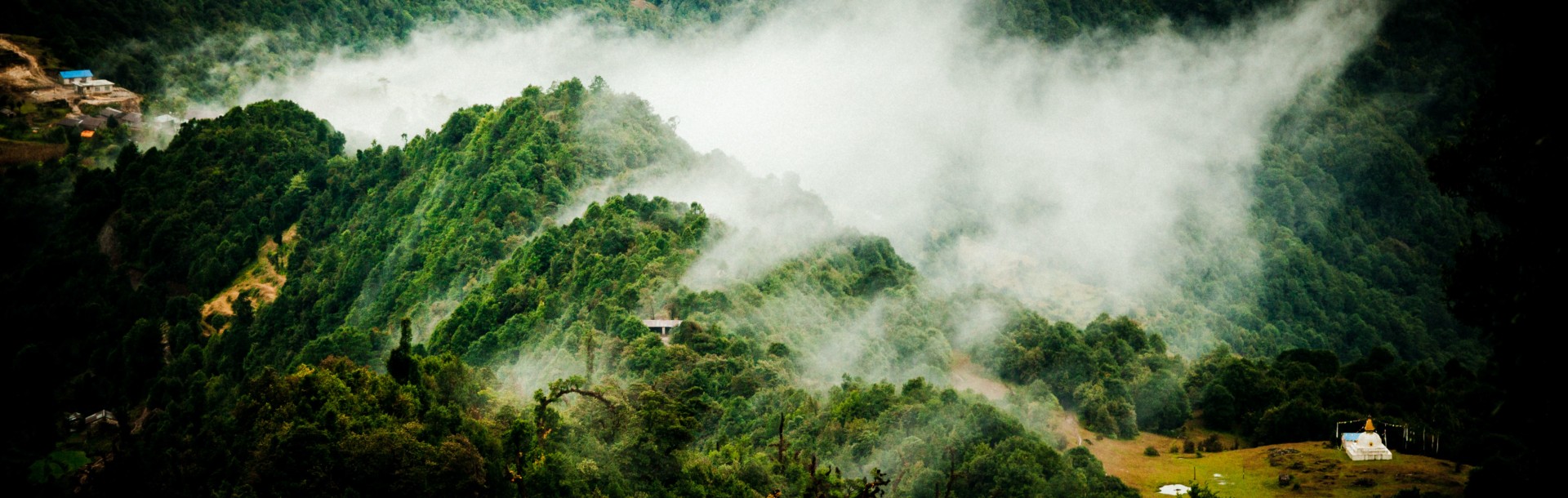
The more we climbed, the more we felt delighted. Though the trail passed through dense forests, we couldn't sight any animals. We, however, could listen to the chirping of birds. We could even see a rejuvenating sight of the waterfall cascading down from a hill across the river, passing through the jungle. We continued our trek, passing through small settlements at Deurali and Dhimsa before reaching our destination for the day – Chandanbari. Chandanbari, which lies at 3,300 meters, is the most preferred site for camping and night stop for trekkers along the route. We stayed at a teashop where we had a good rest after a tedious day of drive and trek.
It was a fine morning. The last day's rain had made the weather pleasant for trekking. We started our second day's trek after having breakfast at Chandanbari. From there, we walked through the pine forest on a straight trail and some steep climbs before reaching Cholangpati. After taking photographs and enjoying the view, we continued our climb.
Similarly, after a trek of about five hours from Chandanbari, we reached Lauribina. The word 'Lauribina' literally means "without a walking stick." Perhaps it tells people that it is impossible to continue the trek if one does not have a walking stick or trekking pole. We resumed our walk after having lunch at Lauribina. It was a challenging ascent, and the steep climb was treacherous. Maybe because of the altitude or the harsh weather, we couldn't see any flora there. Somewhere it was rocky, and somewhere it was plain like a meadow.
Information
On the hill, we could see ruins of a small Buddhist temple destroyed by last year's earthquake. The scary part ended there. From there, it was a pleasant trek ahead, with the trail going straight and downhill in some places. After a few minutes' walk, we saw the first glimpse of Saraswati Kunda. It was quite a sight there. It seemed like the pond was playing hide-and-seek with the clouds. We, however, were successful in taking some snaps of the pond. After a walk of some minutes, we could see Bhairavkunda up on the horizon. As we continued further, we got the first glimpse of Gosainkunda. It was a fantastic experience for me and many of us. We could even see some snow in the area, proof of the heavy snowfall that the place had received a few days ago.
It was already 4 pm when we reached Gosaikunda. Some took a rest in the hotel, some were busy taking pictures, and some were sprinkling holy water of the lake on themselves. The lake was completely different from what I had heard from others. We could see snow in the mountains surrounding this sacred lake, and the view was mesmerizing.
More Info
I heard a lot about Trishuldhara, which is where the water of Gosainkunda originates. Mr. Dangol showed me the place and informed me that the site was a few minutes’ walk away from where we were. I asked some friends if they would like to join me for the short stroll to Trishuldhara. No one was interested; possibly they were tired by the day's trek. But I was determined. Only a fellow trekker, Ms. Shova Khanal, a TAAN staffer, showed some interest in coming along.
After sprinkling the holy water on ourselves, we headed toward Trishuldhara. It took us 20 minutes to reach the place. The place offered us some of the best possible views of Gosaikunda Lake and the surrounding areas. While at Trishuldhara, it made me realize that heaven can be experienced when nature gives you company. After spending some time there, taking some pictures, and enjoying the mesmerizing views of the area, we returned to the hotel. Hotel Lakeside was our accommodation for the day.
Thunderstorms greeted us on the morning of the third day. I was worried that it would rain and make the trail slippery. But to our surprise, there was no rainfall. There was snowfall. It snowed for nearly one and a half hours, depositing one-foot-deep snow in the Gosainkunda Lake area.
TAAN & Gosaikunda
Furthermore, some journalists started playing with the snow while others took pictures. After enjoying the snow for about an hour, we started the descent to Dhunche to cover the concluding ceremony of the half-marathon being organized by TAAN to celebrate its 38th Establishment Day.
Similarly, some stayed back at Gosaikunda to cover the opening ceremony, while others were at Chandanbari to photograph athletes running toward Dhunche. Mr. Dangol stayed at Gosainkunda for the preparation of the event.
Moreover, it was quite a learning experience talking to our coordinator on the way back. We discussed culture, economy, religion, and politics, among other things. The trek was more pleasant than the previous days; it was mostly downhill. We reached Chandanbari at around 2 pm, where we had our lunch. After some rest and lunch, we started our trip back to Dhunche. It was already 7 in the evening when we reached the place. We had to get up early to cover the event, and we ended the day with chit-chats and a nice dinner before calling it a day.
Conclusion
The trip to the holy lake Gosaikunda was a grand success, and our trip also proved that the Gosaikunda trek is as safe as any other place in the world. The success of the half-marathon also played a role in spreading the message that the trails in the Langtang-Gosaikunda region are in good condition, hotels have been rebuilt and are ready to host tourists, and that there is no risk as such.
If you are an adventure enthusiast and nature lover, a trek to Gosainkunda or the Langtang region can be the trip of your life as you can experience local culture, tradition, the lifestyle of the locals, as well as the natural attractions of the place. So grab your gear and head to the adventure of your lifetime. Happy trekking!!
Source: Text – Image Nepal Magazine | A Trek to Remember – Mohan Prasad Mainali
Images:
Photo by Raimond Klavins on Unsplash